Hard to reach
In Malaysia's B40 households (the lower-income 40 per cent) and in rural communities, depression often goes unnoticed and people are not referred for care.
KERICE 2026International Islamic University Malaysia
A Low-Cost Edge Device for Speech-Based Depression Screening
A small device that asks a few simple questions, listens to how a person speaks, and gives health workers an early screening indication. It runs offline, and every recording stays on the device.
We also released pyvoicebox, an open-source Python port of the VOICEBOX speech toolbox
A screening aid, not a diagnosis. The decision always stays with the clinician.
Video
Subtitles are built into the video.
How can you tell when someone is quietly struggling? Around one in twenty adults lives with depression. Even in high-income countries, only about one in three people with depression receive treatment.
In Malaysia's rural and B40 communities, stigma keeps many people from asking for help. Community clinics rarely have the time or the staff to screen everyone. Most tools that could help also run in the cloud, far from where coverage is poor.
So we asked a different question. What if there were a way to spot the signs of depression from the voice alone, on a portable, low-cost device?
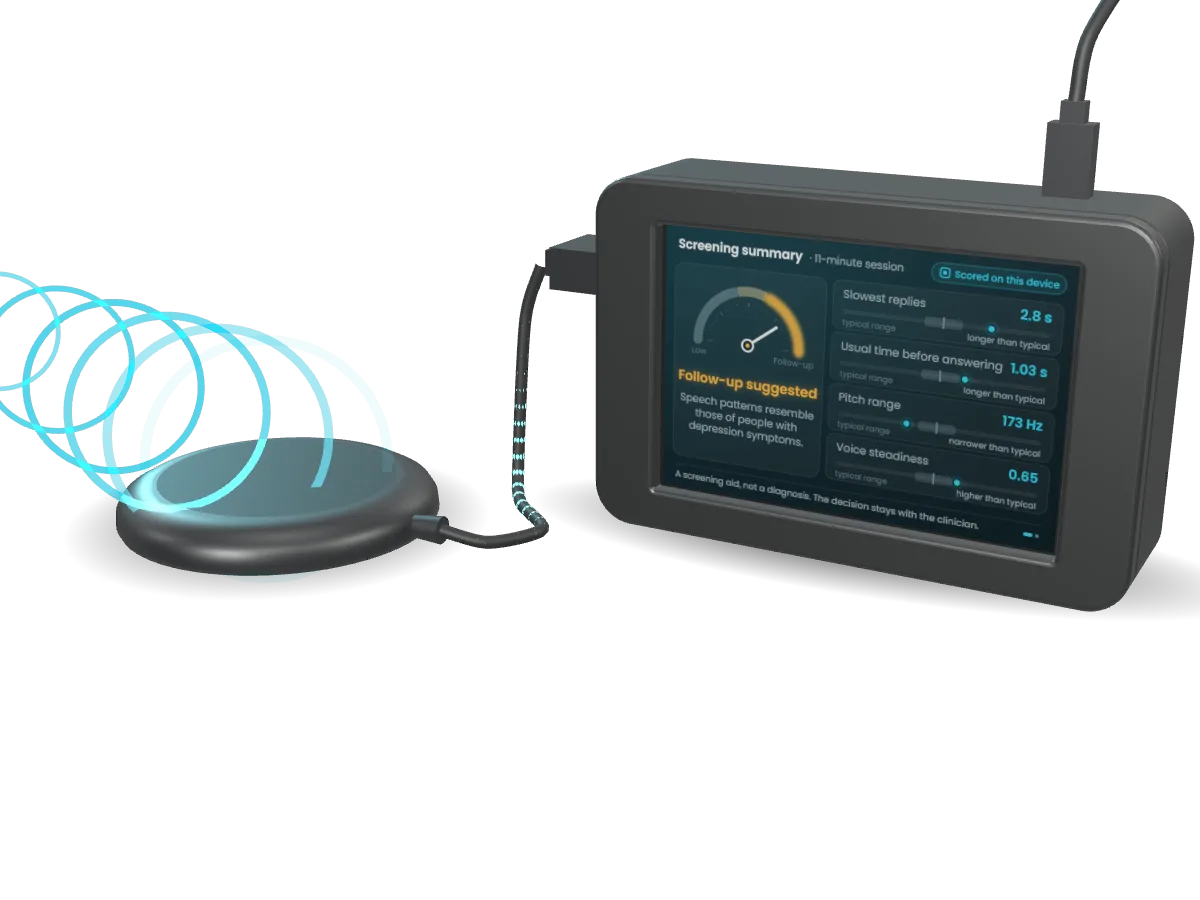
This is our prototype. A Raspberry Pi 5 with a small touchscreen and an external microphone, built for under three hundred dollars.
The person answers a few short, simple questions on the screen. Our model listens in two ways.
First, temporal features, the timing of speech. How long each answer takes to begin, how often the person pauses, and how much of the conversation is theirs. Second, prosodic features, from acoustic analysis of the voice. How far the pitch rises and falls, how steadily the voice is sounded, and how loud it is. Depression often shows as slower replies, longer pauses and a flatter voice.
Its strongest cues come from both families: the slowest replies, how steadily the voice is sounded, and how far the pitch moves. Because it listens to the sound of speech and never to the words, it is designed to work across languages.
Everything runs on the device itself. It needs no internet, and no recording ever leaves the unit. We've tested it on the device, and it runs live, in real time.
Our model file is just 3.6 kilobytes, about a thousand times smaller than one phone photo. Because it is so small, it runs on a low-cost edge device, with no graphics card and no cloud.
Tested on recorded clinical interviews, it is competitive with published speech systems, some of them thousands of times larger.
It gives health workers an early indication of who may benefit from being seen. The decision always stays with the clinician.
Our next phase is to test and validate it with Malay speakers, in a clinical pilot at IIUM Kuantan. Listen early. Refer sooner.
The problem
In Malaysia's B40 households (the lower-income 40 per cent) and in rural communities, depression often goes unnoticed and people are not referred for care.
Stigma keeps many people from asking for help. A quiet, private first step can make it easier to start the conversation.
Most tools that listen for signs of depression run in the cloud. That puts sensitive recordings on someone else's server, and rules them out where the internet connection is poor.
What is missing is a screening aid that is small, offline and private, so people can trust it where stigma is high.
How it works
Depression often shows in speech as slower replies, longer pauses and a flatter voice. The device measures those patterns from the sound alone.
Each question appears on the screen. No interviewer is needed to run a session, and because the device asks each question itself, it knows exactly when the question ends.
A small voice detector (Silero) hears the moment the person starts to reply. The gap in between is their time before answering.
Pauses, how far the pitch rises and falls, and how steadily the voice is sounded. It listens to the sound of speech and never to the words, so it is designed to work across languages.
A 33-parameter classifier turns the measurements into a screening indication, to help decide who may benefit from being seen. The decision always stays with the clinician.
No internet connection is needed. Recordings are processed on the device itself and are never sent to a server.
The prototype
A Raspberry Pi 5 (8 GB) with a 3.5-inch touchscreen and a USB table microphone. Built from off-the-shelf parts for under $300. The device asks each question on its own, so no interviewer is needed to run a session.
Drag sideways to turn it
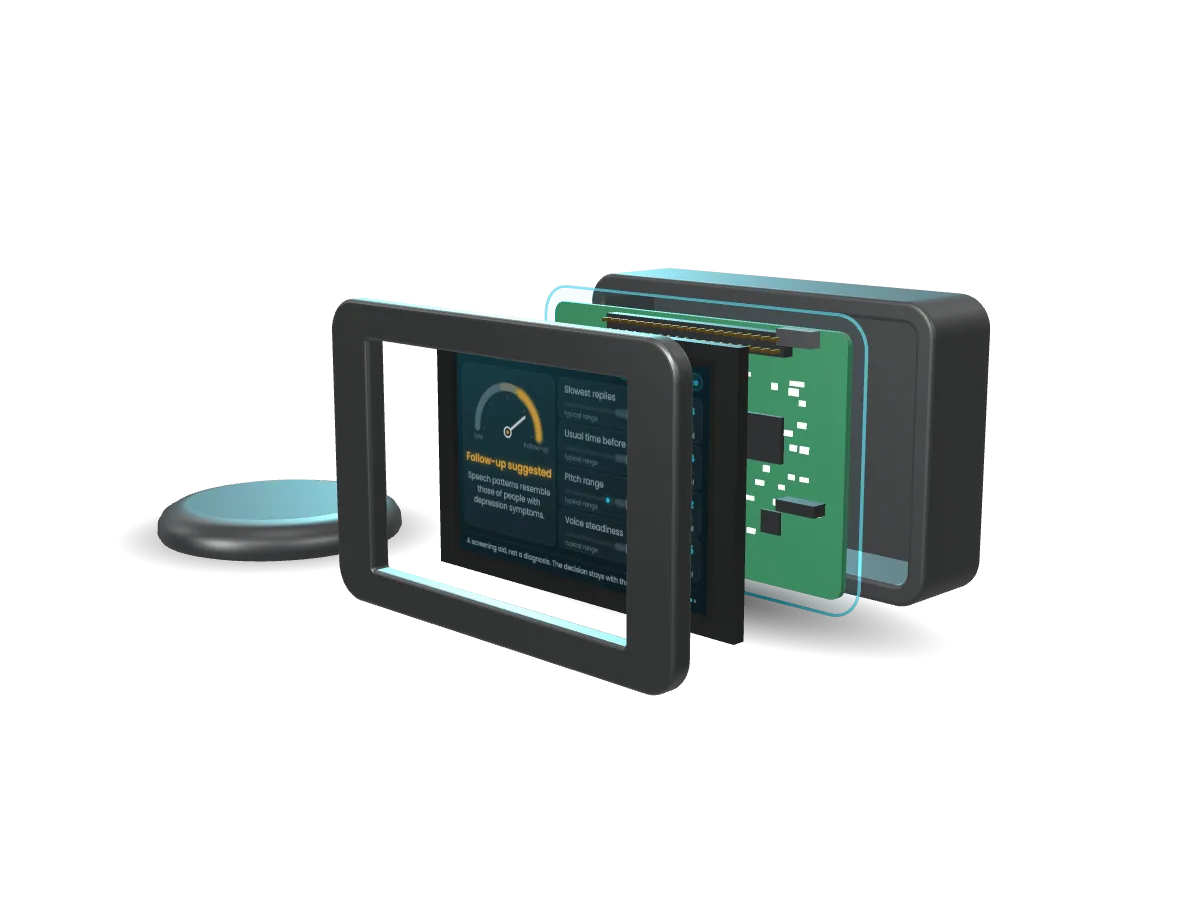
Inside
The voice detector, the measurements and the classifier all run on the Raspberry Pi 5. No cloud server, no internet connection. Recordings never leave the unit.
Raspberry Pi OS (Debian 13), Python 3.13.
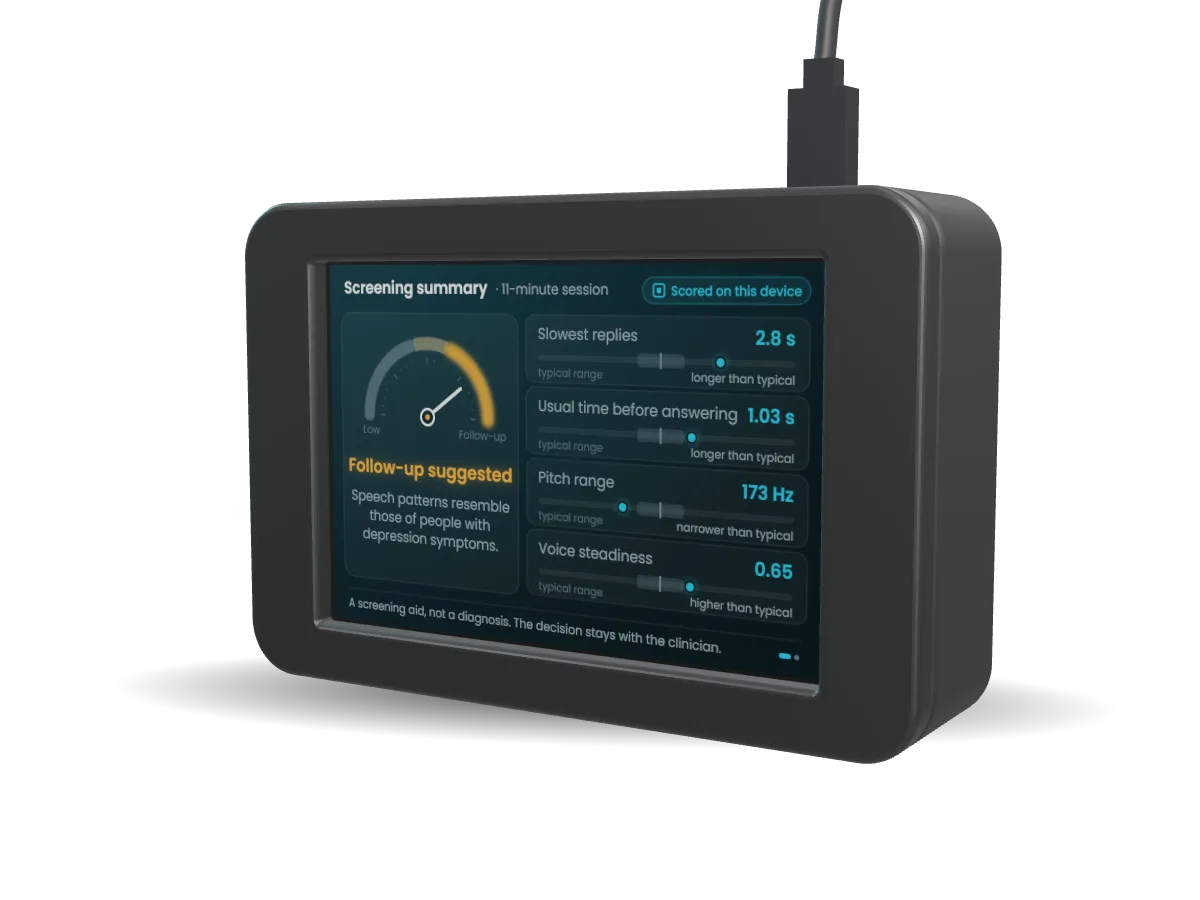
On the screen
After a session, the device shows a short screening summary: an indication, and the four speech measures behind it compared with a typical range.
Illustrative example. Values are group medians from the DAIC-WOZ study data, not a real person's result.
Follow-up suggested. Speech patterns resemble those of people with depression symptoms.
A screening aid, not a diagnosis. The decision stays with the clinician.
Key numbers
11.7 s
on the Raspberry Pi 5, about 55 times faster than real time, once the interview is recorded.
under $300
Off-the-shelf parts: a Raspberry Pi 5, a small touchscreen and a table microphone.
33
Its whole model file is 3.6 KB. No graphics card and no cloud needed.
0.74
How well the scores separate people with and without depression symptoms: 0.5 is a coin toss, 1.0 is perfect. Measured on 189 participants.
Results
On the same clinical interviews, our 33-parameter classifier is in the range of published systems that also use speech alone, including some far larger ones.
The score shown is F1 for the depressed group: it balances how many people with depression symptoms are found against how many of the people flagged really have them. Higher is better.
We compare only with speech-only systems. Systems that read transcripts need a written record of every word, and can pick up clues from the interviewer's questions.
Dev set: the development data used while building a model, which usually scores higher than an unseen test set. Test set: held-out data. Ours: 0.53 cross-validated, 0.65 on the held-out test set.
Open source
The pitch and voice-steadiness measures are computed with pyvoicebox, our Python port of VOICEBOX, the speech-processing toolbox by Mike Brookes at Imperial College London. It is open source (LGPL-3.0) and free to use.
Live demo
A recording of the device running a screening session from start to finish.
Opens on the video host's site in a new tab.
Team
Funded by the Prototype Development Research Grant Scheme (PRGS25-029-0073), Ministry of Higher Education Malaysia.